




Harvey John
Unit 2 Ferry Wharf
Hove Enterprise Centre
Basin Road North
Portslade, East Sussex
BN41 1BD
27th February 2024
Mastering Operational Transfer Pricing (OTP) is now essential for companies aiming for financial efficiency and global compliance. Demand for simpler, more effective solutions is growing faster than ever.
What is OTP and why is it relevant?
OTP is the process of managing transfer pricing data, systems, and governance using technology. A well-executed OTP programme should align transfer pricing with business goals. It supports compliance, simplifies complex processes, and provides strategic insight for better decision-making.
And even better – OTP is not just for transfer pricing. It’s a versatile tool with use cases in finance, supply chain, treasury, regulatory matters, and executive-level decision-making.

The lead-up to OTP solutions
In the evolution towards robust transfer pricing solutions, multinationals have traditionally leaned on ERP systems to oversee business operations. However, these systems often struggle to manage transfer pricing effectively, leaving many organisations still relying on manual processes or external tools, which are becoming unsustainable.
The landscape changed significantly with the OECD’s Base Erosion and Profit Shifting (BEPS) project and Pillar Two. These changes increased scrutiny and made compliance more complex. In response, automation and technology have become essential, helping organisations manage large data volumes and maintain compliance.
The move to cloud-based ERP systems creates an opportunity to reconfigure financial data. This shift helps align data with transfer pricing calculations and reporting requirements, improving efficiency and overall management.
Do you bring OTP in-house or outsource it?
- Consistency and continuity – in-house specialists understand the OTP setup and retain knowledge internally
- Cost control – reduces reliance on expensive external advisors
- Real-time integration – easier collaboration across teams
Borys Ulanenko also stressed the need to avoid over-reliance on a single in-house specialist and to have a contingency plan in place. As he noted, all processes should be well documented, with clear technology and human support systems in place, rather than relying solely on manual spreadsheets.
Borys Ulanenko also stressed the need to avoid over-reliance on a single in-house specialist and to have a contingency plan in place. As he noted, all processes should be well documented, with clear technology and human support systems in place, rather than relying solely on manual spreadsheets.
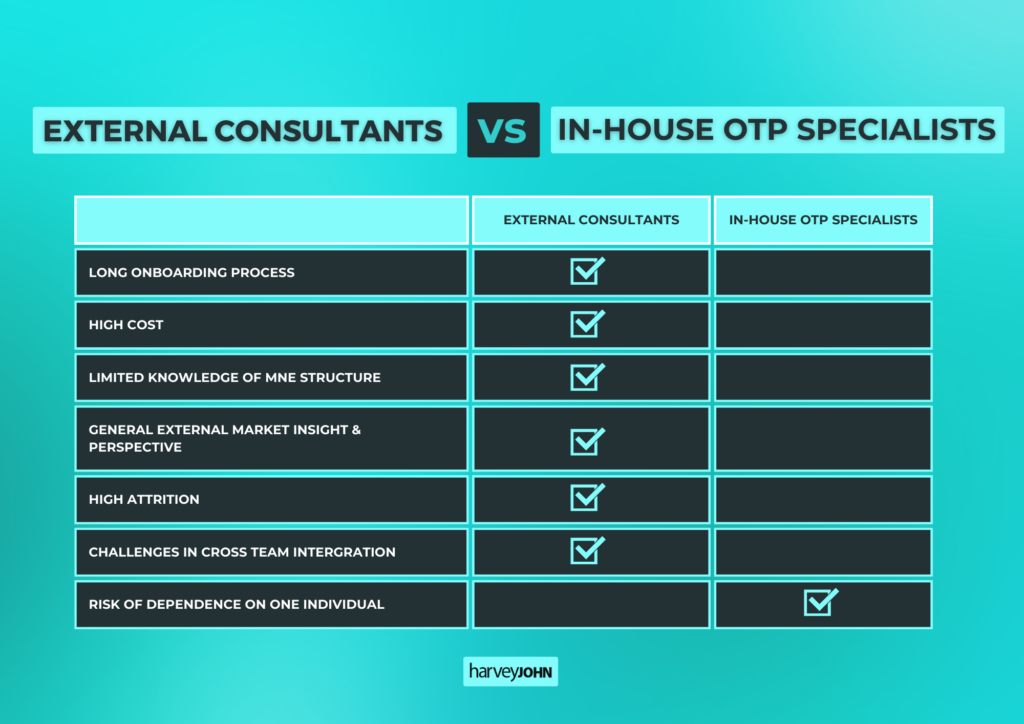
Dr Frank Schoeneborn, the Global Head of EXA’s Operational Transfer Pricing Software also shared his insights on one of the key challenges with outsourcing OTP – the added complexity and coordination it can introduce:
“Many aspects seem to be critical when it comes to the decision of letting others do a managed service in operational transfer pricing. Onboarding external consultants to the business dynamics as well as business and process knowledge incl. ERP landscape is just the first step. For efficiency gains to be realised from outsourcing operational TP activities, it needs documenting and explaining existing processes, to agreeing new target operating procedures e.g for P&L segmentation, forecasting and TP setting incl. monitoring performance to what degree these steps have been successfully and timely completed. Even with professional OTP technology used to automate data gathering and data computation, there is a large risk of creating additional layers of management and coordination as there can be some doubt, if an external service provider is really taking decision what and why to change prices in daily business operations significantly influencing financial results. There can be some doubt, to what degree operational TP management activities can be outsourced in the view of competency as well. In the field of operational TP, MNEs need cross functional experts being able to speak business language as well as the terms of international tax from a compliance perspective.”
What about OTP software?
Advanced software helps manage OTP by automating data collection, compliance, and reporting, reducing reliance on spreadsheets.
Dr. Frank Schoeneborn emphasises the critical need for professional OTP software, highlighting the limitations of spreadsheets. He emphasises managing software onboarding, training, data, and system access, addressing technical needs and security, paving the way for specialised OTP operations.
The critical role of an OTP specialist
The perspectives of both experts show that implementing OTP is an intricate process, requiring careful consideration of various factors to ensure smooth operations.
Consequently, securing the right talent for an OTP team is essential for successful implementation, enabling effective risk monitoring, opportunity identification, and comprehensive reporting to both internal and external stakeholders. This isn’t just another hire – it’s a strategic role that supports real-time insights and decision-making. These professionals support scenario modelling, analyse logistics costs, and provide insights to the C-suite.
In summary, successful OTP implementation will allow a business to:
- Run real-time scenario simulations and financial forecasts
- Model supply chain and logistics costs
- Assess carbon impact against ESG targets
- Support regulatory reporting requirements
- Provide clear insights for strategic decision-making
If you’re a tax or finance leader looking to strengthen your in-house transfer pricing capabilities, please reach out to our specialist TP recruiter: Ewa Milner-Walker (UK and Europe), and Jim Huber (US), for more information.
Originally published 27 February 2024. Last updated 1 April 2026.
Share this article:
Author

Prior to joining the recruitment industry, Ewa had a career in real estate in New York City & London. She prides herself on working closely with clients and candidates to help them to find the best match for their requirements and career objectives.
Ewa is happy to converse in English, German, Italian as well as her native Polish.